Introduction
If a tree has come down on your property in Preston, Leyland, or anywhere else in Lancashire, you’re probably feeling a mix of shock and urgency right now. That’s completely normal. Storm damage is one of those situations where the decisions you make in the first hour matter more than at almost any other point in the process for your safety, for your legal position, and for how smoothly your insurance claim goes.
This isn’t the moment to guess or to rely on a five-minute YouTube video. I’ve been working as a professional arborist for over 15 years, across both the UK and New Zealand, and I’ve seen first-hand what happens when well-meaning homeowners try to tackle storm damaged timber themselves. Below is a detailed, professional guide covering exactly what to do, why DIY removal is far riskier than it looks, and how to protect yourself legally and financially.
Quick Action Guide: What to do in the first 15 minutes
- STOP: Do not attempt to move, cut, or climb on the tree yourself. Unless you are a trained and insured arborist, you are putting yourself at serious risk of injury.
- CHECK: Look (from a safe distance) for downed power lines, damaged gas meters or pipework, and any structural damage to your home, garage, or neighbouring property.
- CALL: Use the priority order below to work out exactly who you need, as the right call first time saves hours.
- DOCUMENT: If it is safe to do so, take photographs from several angles of the tree and any damage it has caused, before anything is moved or cleared.
Determining Urgency: Who to Call First
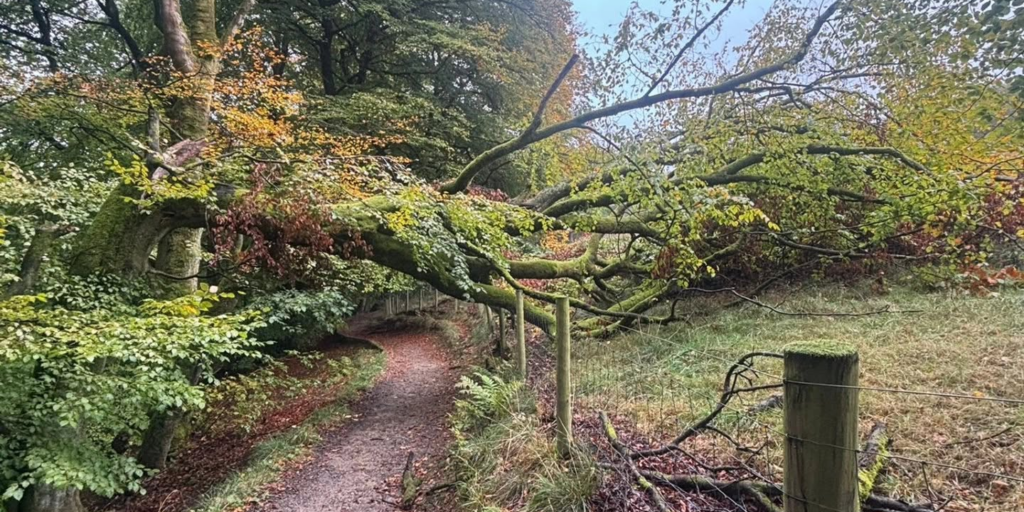
Not every fallen tree is a job for an emergency tree surgeon straight away, sometimes another authority needs to be involved first. Understanding whose responsibility the tree falls under is the first step to resolving the situation quickly.
- Life-Safety Emergencies (Call 999): If a tree has fallen across a public road, is trapping someone, or has caused structural damage severe enough that your home is unsafe to remain in, contact the emergency services immediately.
- Highways and Public Roads: If a tree is blocking a road anywhere in Lancashire, contact Lancashire County Council’s highways team, or the police on 101. They are responsible for clearing debris from public rights of way.
- Power Lines: If electricity cables are tangled in the tree or have been brought down with it, stay at least 10 metres away and contact your local electricity network operator’s emergency line straight away. Never assume a cable is safe just because it looks undamaged.
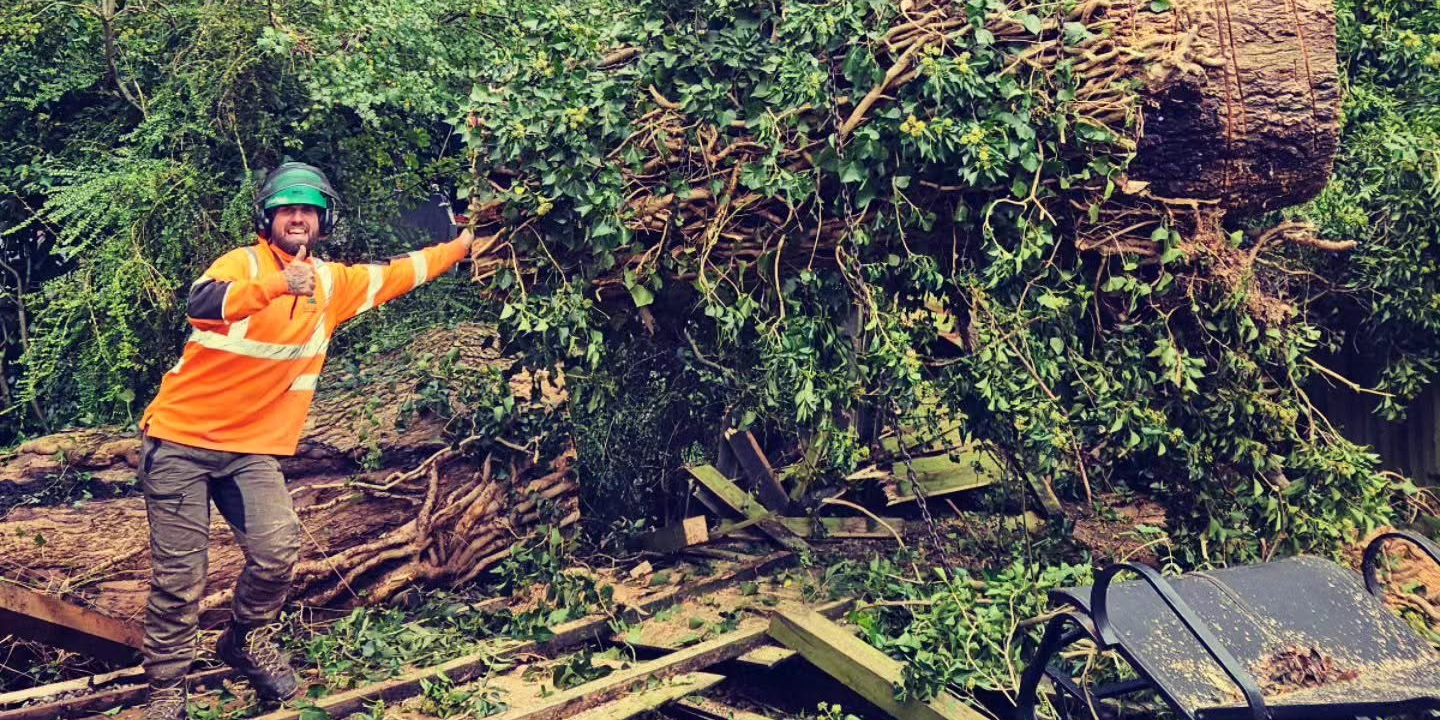
- Private Land: If the tree is on your own property and is damaging your house, garage, fencing, or garden structures, you need a qualified arborist with the right equipment such as winches, rigging gear, and in some cases a crane, to bring the timber down safely and in a controlled way. This is exactly the kind of job we handle regularly across Leyland, Chorley, Euxton, Croston, Eccleston and Buckshaw Village, including full tree removal services.
Why DIY is a Critical Mistake
It’s tempting to grab a chainsaw and start clearing the mess yourself to save money. As professionals, we strongly advise against this. The Health and Safety Executive (HSE) is blunt about it; tree work is consistently one of the most dangerous industries to work in, and storm-damaged timber is significantly more hazardous than a routine felling job.
Tension and Compression:
A tree lying on the ground after a storm is rarely stable. The trunk may be bent under tension like a drawn bow, or crushed against the earth under compression. Cut into the wrong part of that wood without understanding the forces at play, and the trunk can snap back, roll, or shift with genuinely lethal force. This is precisely why industry bodies that sit on HSE’s Arboriculture and Forestry Advisory Group continue to stress that emergency tree work involving windblown or part-blown trees should only ever be carried out by experienced, trained professionals, and not attempted by landowners themselves, however capable they feel with a chainsaw.
The “Widow-Maker” Effect:
Storms don’t just bring whole trees down, they also snap and dislodge branches high in the canopy of neighbouring trees, leaving them precariously “hung up” among other limbs. These branches are heavy, often invisible from ground level, and can fall without warning while someone is working underneath. HSE guidance and fatal incident reports from the sector return to this hazard again and again; being struck by a falling tree or branch remains one of the most common causes of serious injury and death in arboriculture.
Root Plate Instability
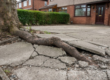
If a tree has partially uprooted rather than snapped, the root plate (the disc of soil and roots at its base) can weigh several tonnes and is often balanced in a highly unstable position. Cut the trunk in the wrong sequence and that root plate can spring back upright or collapse into the hole it left behind, with more than enough force to cause a fatal crush injury.
Professional Safety Protocols
When our team arrives at a site in Preston, Leyland, or anywhere else in the region, we don’t simply start cutting. Our process is built around the same principles that underpin HSE and Arboricultural Association guidance for the sector:
- Site Risk Assessment: Identifying hung-up branches, root plate movement, and trip or slip hazards before any tool is picked up.
- Tension-Release Techniques: Using winches, ropes, and carefully sequenced cuts to release stored energy in the wood safely, rather than cutting blind.
- PPE and Mechanical Aids: Full protective equipment for every team member, combined with mechanical advantage (winches, slings, and where needed a crane) to remove weight from the tree before it’s dismantled piece by piece.
Insurance, Liability, and The “Act of God”
Navigating the financial and legal side of storm damage is often just as complicated as the physical clean-up.
Act of God: If a healthy, well-maintained tree comes down during a genuinely severe and unpredictable storm, insurers will often treat this as an “Act of God,” and your standard buildings or home insurance is likely to cover the resulting damage.
Negligence: If you’d previously been warned that a tree was diseased, structurally unsound, or dangerous, and chose not to act, you could be held liable for any damage it causes. This is one of the main reasons landowners are encouraged to keep on top of routine tree inspections rather than waiting for a problem to become obvious.
The Audit Trail: This is exactly why regular tree surveys matter, even when nothing looks obviously wrong. A dated, professional report from a qualified arborist becomes evidence that you have acted as a “reasonable and prudent” landowner, and that you carried out proper due diligence in maintaining your property which is something insurers and, if it ever comes to it, courts, will want to see.
Should I clear the debris before the insurance assessor arrives?
No, not until the damage has been properly documented. Take wide shots of the whole scene, then close-ups of any damage to your roof, fencing, vehicles, or outbuildings. Report the incident to your insurer as soon as possible, and ask whether they have a preferred list of contractors, but remember you’re entitled to choose your own local, responsive professional rather than being tied to whoever the insurer suggests.
Protected Trees and Legal Compliance
Many trees across Lancashire, particularly in and around conservation areas in Chorley, Leyland, and South Ribble are protected by Tree Preservation Orders (TPOs), and this creates a legal trap that catches out a lot of well-intentioned homeowners.
Can I remove a protected tree if it has fallen in a storm?
You need to be careful even when a tree is clearly damaged. Under GOV.UK’s own guidance on TPOs, removing or working on a protected tree without permission, even after storm damage is a prosecutable offence if the danger genuinely wasn’t immediate, and local authorities are entitled to require a replacement tree to be planted even where emergency work was justified.
Is there an emergency exception?
Yes, but the burden of proof sits with you. Most councils, in line with national guidance, allow “make-safe” emergency work where there’s an immediate risk of serious harm, provided you can demonstrate that the danger genuinely couldn’t wait. In practice this means photographing the tree thoroughly before any work takes place, and in many council areas, notifying the local planning authority in writing as soon as reasonably possible afterwards.
Rather than navigating this alone, we’d strongly recommend letting a professional handle the communication with your Local Planning Authority. Our Tree Surveys and TPO Applications service exists specifically to manage this kind of application, ensuring the work is properly logged, evidenced, and approved, which protects you from the legal and financial fallout of an unauthorised felling.
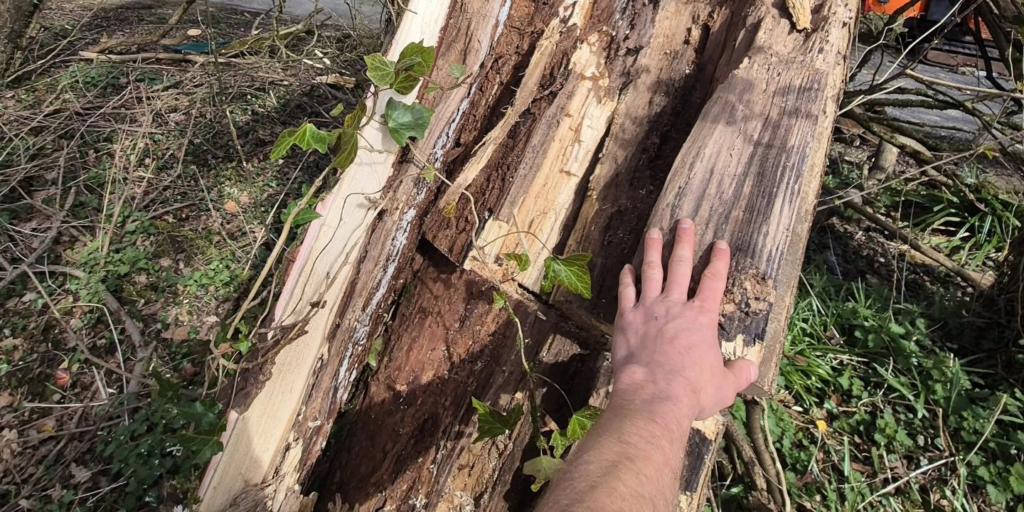
Identifying “Hidden” Storm Damage
Sometimes the most dangerous damage isn’t obvious. A tree can remain standing after a storm while its structural integrity has been quietly compromised. Watch for these warning signs:
- Vertical Cracks: Even a thin crack in the bark can indicate the trunk is under severe stress and could fail in the next gust.
- Soil Mounding: Check the ground on the side opposite any lean. Cracking or lifting soil is often a sign the root system is failing.
- Crown Dieback: Wilting or browning foliage on one side of the tree can indicate that the roots beneath it have been severed or crushed.
- Fungal Growth: Mushrooms or bracket fungi appearing on the roots or trunk shortly after a storm can point to internal decay that has been aggravated or exposed by the tree’s movement.
If you spot any of these signs, don’t assume the tree is safe simply because it’s still standing. Book a professional tree survey to get a proper, qualified assessment of whether the tree can be saved or needs to come down.
What Does Emergency Tree Work Cost?
Pricing for emergency tree removal depends on the size of the tree, its position relative to buildings or roads, how much rigging or crane work is required, and how urgently the job needs doing. For a general sense of how tree surgery is typically priced in this region, our guide on how much do tree surgeons charge breaks this down in more detail. We’re always upfront about cost before starting any work, and where a claim is involved, we’re happy to liaise directly with your insurer or loss adjuster.
Why Choose Tree Care Extraordinaire
I’m Harry Watkinson, and I’ve run Tree Care Extraordinaire since founding the business after building up over 8 years of hands-on experience across the domestic and commercial arboriculture sectors, both in the UK and New Zealand. Our work conforms to BS3998 (Recommendations for Tree Work) and the Health and Safety at Work etc. Act, and we’re recognised as a Trusted Trader alongside holding City & Guilds qualifications. You can read more about our background here.
Need Emergency Tree Assistance in Lancashire?
If you have a tree down in Preston, Leyland, or anywhere in the surrounding area, we’re on hand to make your site safe. We specialise in high-risk removals and storm damage clean-ups, and prioritise call-outs based on the severity of the hazard to your property.
Get in touch today with your location, contact number, and a photo of the tree, and we’ll respond as quickly as possible.
References:
https://www.hse.gov.uk/treework/index.htm
https://www.hse.gov.uk/foi/internalops/sims/ag_food/010705.htm
https://www.gov.uk/guidance/tree-preservation-orders-and-trees-in-conservation-areas