Introduction
Disputes about trees growing across property boundaries are incredibly common. As an arborist working with homeowners across Preston, Leyland and the wider Lancashire area, I regularly hear from people who are unsure what they are actually allowed to do when a neighbour’s tree starts growing into their garden. Most commonly, the original problem sounds fairly minor with the likes of a branch scraping against a roof, or a tree gradually blocking more and more light. What makes these situations difficult is that a relatively small tree problem can quickly turn into a disagreement about property rights, responsibility, safety and, sometimes, who is expected to pay for the work.
The law does provide homeowners with useful rights where branches or roots cross onto neighbouring land, but those rights have limits. You cannot simply treat the part of a tree hanging over your garden as though you own it, and the fact that you can potentially remove an encroaching branch does not give you a general right to reshape your neighbour’s tree. There are also additional considerations where the tree is protected, where nesting birds or other wildlife may be affected, where the tree is genuinely dangerous, or where roots or branches are causing actual damage.
The important thing is to establish exactly what situation you are dealing with before reaching for the saw. This guide focuses primarily on England and Wales, because the legal framework is not identical throughout the UK. If you live in Scotland or Northern Ireland, you should check the rules that apply in your own jurisdiction before carrying out work, however some may still be applicable.
Can I Cut Branches Off a Neighbour’s Tree?
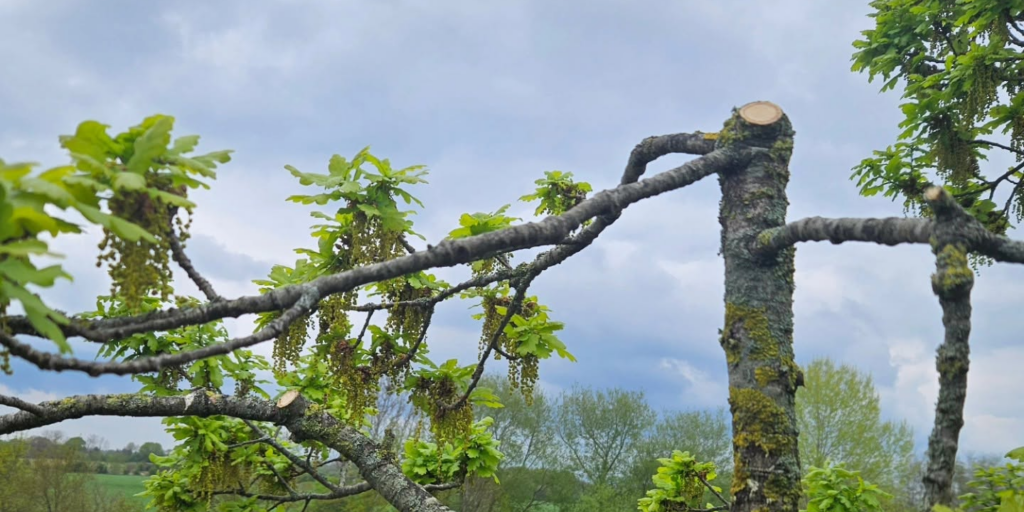
Generally, yes. In England and Wales, there is a long-established common-law right to remove branches and roots from a neighbouring tree where they have crossed onto your land. This is commonly referred to as the right of abatement. GOV.UK confirms that you can generally trim branches or roots that cross into your property, but only as far as the property boundary [4].
This is not a modern rule created specifically for residential gardens. The principle has existed in common law for centuries, with Lemmon v Webb [1], decided by the House of Lords in 1894, being the leading authority usually associated with overhanging branches. The case considered whether a person whose land was being overhung could remove the branches without first notifying the tree owner, and the court confirmed that the branches could be removed from the affected person’s own land.
That means an overhanging branch does not necessarily need to have damaged your property before you can deal with it. The physical encroachment itself can be enough to give rise to the common-law right. What matters is that the branch or root has actually crossed the boundary and that your work remains within the limits of that right.
It is worth making a distinction between a legal right and a sensible course of action, though. Just because you may be entitled to remove an overhanging branch does not mean that every type of pruning is sensible. A mature tree is a living structure, and removing a large limb simply because it crosses the boundary can have consequences for the tree’s balance, appearance and future health.
This is where professional tree care and pruning can be useful. The objective should be to resolve the overhang without creating a second problem through unnecessary or poorly considered pruning.
Do I need to ask my neighbour before cutting the branches?
You do not generally need your neighbour’s permission simply to exercise the common-law right to remove branches that have crossed onto your property. The long-standing position established in Lemmon v Webb [1] is that prior notice is not a prerequisite where the work can be carried out from your own land.
In practice, however, I would nearly always recommend talking to your neighbour first. Most tree disputes become much harder once both sides feel that the other has acted without speaking to them. Your neighbour may not even realise how far the tree has grown, may be perfectly happy to arrange the work themselves, or may prefer that you use a particular contractor.
A conversation also gives you the chance to agree what is actually going to be removed and what will happen to the cut branches afterwards. GOV.UK recommends trying to resolve neighbour disputes informally before escalating the matter, and in my experience that is particularly sensible where a living tree is involved.
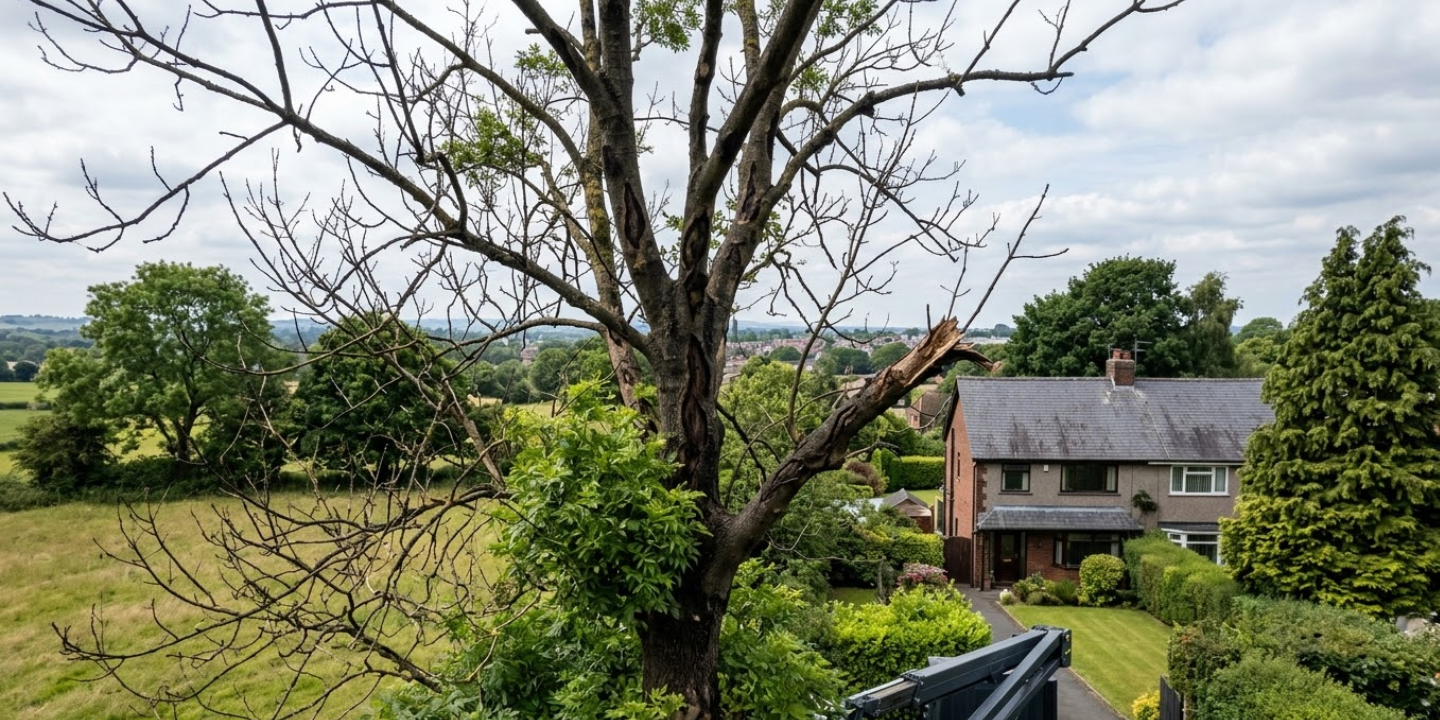
Can I Cut My Neighbour’s Tree That Is Overhanging My Garden?
Yes, but the important words are “that is overhanging my garden”. You are not acquiring ownership of the tree simply because some of its branches are on your side of the boundary. Your right is generally to deal with the part that has physically encroached onto your property.
For example, imagine that your neighbour has a mature oak planted entirely within their garden. Over time, several substantial branches have grown across the fence and now extend several metres above your lawn. You can generally remove the portions of those branches that are on your side of the boundary.
What you cannot do is decide that because part of the canopy is over your garden, you can now manage that entire side of the tree. The right to abate an encroachment is not the same as a right to control your neighbour’s tree.
The same principle can apply to roots. Roots that have crossed onto your land can generally be cut back to the boundary, but root pruning carries additional risks. Removing a major structural root can affect the stability of a mature tree, particularly where the tree is large or exposed to wind.
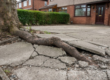
If you are seeing cracked paving, raised slabs or other possible symptoms of root problems, it is worth looking at the cause before simply cutting roots. Our guide to tree roots lifting your driveway or patio explains some of the common reasons roots can affect hard surfaces and why it is important to establish what is actually happening.
How Much of My Neighbour’s Tree Can I Cut?
The general rule is straightforward: you can normally cut encroaching branches or roots back to the boundary, but not beyond it [4].
This sounds simple on paper, but trees do not grow in straight lines and property boundaries are not always as obvious as they appear. A branch might cross the boundary several metres above the ground and form part of a much larger limb. The point at which an arborist would ideally make a pruning cut from a tree-health perspective may be further back than the point to which you have the legal right to cut.
That is why “cut everything back to the fence” is not necessarily a good instruction to give a contractor. A professional arborist needs to consider the tree’s structure as well as the legal boundary.
A poorly chosen cut can leave an unnecessarily large wound, create an unattractive imbalance or encourage weak regrowth. Our article on crown thinning and crown reduction explains the difference between different types of professional crown work and why the objective should be considered before branches are removed.
Can I Cut the Whole Side of the Tree Back?
Not simply because that side of the canopy happens to be over your garden. The ordinary right of abatement relates to the encroaching growth. It does not give you a general right to reduce the tree, reshape it or dismantle a large part of its crown.
This is particularly important where a tree has grown significantly across a boundary over many years. You might have a situation where a third or even half of the canopy is above your garden, but that does not mean you can remove every branch on that side regardless of what the work does to the tree.
If the tree genuinely needs a larger reduction, that should be discussed with the owner and approached as tree management rather than simple boundary pruning. Our Tree Reduction service covers professional crown reductions where reducing the height or spread of a tree is appropriate.

Can You Cut Overhanging Branches From a Neighbour’s Tree in the UK?
In England and Wales, generally yes, provided the branches have actually crossed onto your land and you stay within the legal limits. You also need to consider whether the tree is protected, whether wildlife could be affected and whether the proposed work is safe.
The easiest cases tend to involve a few relatively small branches that are accessible from your own garden. The more complicated cases are mature trees, substantial limbs over buildings, trees growing close to overhead services or situations where the legal boundary itself is unclear.
There is also an important distinction between being entitled to remove an encroachment and being entitled to carry out whatever pruning would produce the appearance you want. The first is a limited common-law right, however the second is generally a matter for agreement with the tree owner.
Can I enter my neighbour’s garden to prune the tree?
No automatic right of access comes with the right to remove overhanging branches. Your ability to deal with the encroachment on your land does not give you permission to climb over the fence, enter your neighbour’s garden or position equipment on their property without consent.
This becomes particularly relevant with larger trees. A branch may be over your garden but physically impossible to remove safely from your side without specialist equipment or access from the neighbouring property. In those circumstances, access needs to be agreed with the owner or the appropriate legal route considered.
Never assume that because you have a right to cut a branch, you automatically have a right to enter the land on which the tree grows.
What should I do with branches after they are cut?
The branches and other cut material can become another source of disagreement if nobody discusses what happens to them. In general, material removed from a neighbour’s tree remains the property of the tree owner, so the sensible approach is to offer it back rather than simply disposing of it without discussion.
In practice, most neighbours will be perfectly happy for the person arranging the work to dispose of the cuttings. The important thing is to agree this beforehand. A professional tree surgeon can normally deal with the removal as part of the job, making the whole process considerably easier.
Is There a Legal Height for Neighbour’s Trees in the UK?
For an individual tree, there is generally no universal legal height limit simply because it stands near a neighbouring property.
This is one of the biggest misconceptions I come across. Homeowners often hear that there is a “two-metre rule” and assume that any tree over two metres is automatically illegal. That is not the case.
The two-metre threshold is associated with the statutory high-hedge regime, not a general height restriction for individual trees. A mature oak, beech, sycamore or similar specimen can be considerably taller than two metres without becoming unlawful simply because of its height.
That does not mean a very tall tree is never a problem. Height can be relevant to structural risk, shading, property damage and the overall impact a tree has on a neighbouring property. It simply means that there is no general rule saying an individual tree must be kept below a particular height.
What Can I Do If My Neighbour’s Trees Are Too High in the UK?
The answer depends on what you mean by “too high” and, importantly, whether you are dealing with an individual tree or a qualifying high hedge.
If one large tree is blocking light into your garden, dominating the view or simply looking much too large for its surroundings, there may be no straightforward legal route to force the owner to reduce it. A disagreement about a tall individual tree is not automatically the same thing as a high-hedge complaint.
Where several evergreen or semi-evergreen trees or shrubs form a qualifying high hedge, the situation is different. Part 8 of the Anti-social Behaviour Act 2003 [2] provides a statutory process for complaints where a qualifying hedge is adversely affecting the reasonable enjoyment of a domestic property [6].
This is an area where professional assessment can be useful because a tree reduction, a crown thinning, a high-hedge complaint and a legal nuisance are four different things. Our article Does My Tree Need to Come Down? looks at the difference between removal and reduction and can help explain why reduction is often considered before complete removal.
What rights do I have if my neighbour’s trees are too high?
Your rights depend on the circumstances rather than simply the measurement of the tree.
If branches have crossed your boundary, you may have the common-law right to remove the encroaching growth. If the vegetation is a qualifying evergreen or semi-evergreen high hedge, the statutory complaint procedure may be available. If the tree is causing actual property damage or presents a genuine safety risk, nuisance or negligence issues may also become relevant.
What you do not generally have is an unrestricted right to demand that a tall individual tree next door is reduced simply because it is tall or because you would prefer more sunlight.
Where a tree owner agrees to reduce the tree, professional crown work may be an appropriate solution. Our Tree Reductions service explains how reductions can be used to reduce overall tree height and canopy spread while retaining the tree.
Who Pays to Cut Back Overhanging Trees?
For a straightforward overhanging branch, the person exercising the right to remove the encroachment would generally pay for arranging the work. There is no general rule requiring the tree owner to pay merely because they own the tree.
This surprises some homeowners because the tree is, after all, physically growing from the neighbour’s property. However, the common-law right is giving the affected neighbour a remedy, with the ability to remove the encroaching growth themselves.
The situation can become more complicated where the tree has caused actual damage. If roots are contributing to damage to a building or drainage system, or if there is evidence that a dangerous tree has created a foreseeable risk that the owner has failed to address, the issue may move beyond simple boundary pruning into nuisance or negligence.
This is particularly important with alleged subsidence. A crack in a driveway or wall does not, by itself, prove that a tree is responsible. Our detailed guide on tree-related subsidence explains why identifying the actual cause of damage is so important before deciding what should happen to a nearby tree.
What Is Classed as a Nuisance Tree?
“Nuisance tree” is a phrase people use regularly, but it is not a simple legal category where any tree that causes irritation becomes a nuisance.
A neighbour’s tree dropping leaves, creating some shade or growing tall does not automatically amount to an actionable nuisance. The circumstances, seriousness and nature of the interference matter.
A straightforward overhang is normally dealt with through the common-law right to remove the encroaching branches or roots. A more serious case might involve repeated physical damage, substantial interference with the use and enjoyment of a property or a genuinely dangerous tree where the owner has failed to take reasonable steps after becoming aware of the risk.
For example, occasional leaf fall in autumn is normally part of living near trees. Repeated root-related damage to drainage, paving or structures is a different proposition. Similarly, an old or very large tree is not necessarily dangerous simply because of its size; its condition and structural risk need to be assessed.
Where you are concerned about serious root damage, our Tree Roots Lifting Your Driveway or Patio guide is a useful starting point. For more significant concerns, a professional tree survey and assessment can help establish what is actually happening before action is taken.
Is It a Criminal Offence to Cut a Neighbour’s Tree?
It can be, depending on the circumstances.
Simply exercising the ordinary common-law right to remove an overhanging branch back to the boundary is not, by itself, generally a criminal offence. The situation becomes much more serious when someone cuts beyond the boundary, substantially damages or removes a neighbour’s tree, carries out unauthorised work on a protected tree, or damages wildlife protected by law.
This is why I would always recommend checking the tree’s status before arranging significant pruning. “It’s only a few branches” is not enough to assume that no restrictions apply.
Is it illegal to cut down my neighbour’s tree?
You should not assume that an overhanging tree can be felled because some of its branches extend into your garden.
The common-law right to remove encroaching growth does not give you a general right to fell the tree, remove its main structure or substantially reduce it. Cutting beyond the boundary can also expose you to a civil claim because you may be damaging property that belongs to your neighbour.
If a tree genuinely needs to be removed because it is dead, dangerous, diseased or unsuitable for its location, that should be assessed as a tree-removal question, not treated as an extension of your right to trim overhanging branches.
Our Tree Removal service covers situations where removal is considered the appropriate option.
What if the tree has a Tree Preservation Order?
This is one of the most important checks to make before any significant tree work. A Tree Preservation Order, or TPO, provides legal protection to specified trees or woodlands. Depending on the order and the circumstances, cutting down, topping, lopping, uprooting, wilfully damaging or destroying a protected tree without the necessary consent can be an offence [5].
Trees in conservation areas can also be subject to specific controls, and in many cases the local planning authority must be notified before certain work is carried out [5].
A tree being protected does not necessarily mean that it can never be pruned. It means you need to establish what permissions or procedures apply before the work takes place.
Our article How to Find Out if a Tree is Protected explains how homeowners can check the protection status of a tree. We also provide Tree Surveys and TPO Applications for homeowners who need professional help assessing a tree or dealing with a planning application.
What about nesting birds?
Tree work is not solely a property-law issue. Wildlife legislation also needs to be taken into account.
Under the Wildlife and Countryside Act 1981 [3], it is an offence to intentionally take, damage or destroy the nest of a wild bird while it is in use or being built [8]. Some species receive additional protection, including protection against disturbance while nesting.
That does not mean all tree work is automatically illegal between March and August, as is sometimes claimed online. The important question is whether nesting birds or other protected wildlife are actually present and whether the proposed work could affect them.
A responsible contractor should therefore inspect the tree before work begins and adapt, postpone or reconsider the work where necessary. This is another reason not to treat significant tree surgery as a purely DIY exercise.
What Should I Check Before Cutting an Overhanging Tree?
Before carrying out any work, establish exactly what situation you are dealing with. If it is simply a small branch crossing the boundary, the common-law position may be relatively straightforward. If there is a boundary dispute, a protected tree, substantial root damage, a dangerous tree or a qualifying hedge, the correct course of action may be very different.
The practical checks I would recommend are:
- Establish the boundary. Do not automatically assume that the fence is the precise legal boundary [7], particularly where there is an established disagreement between neighbours.
- Identify the tree owner. This will normally be the person who owns the land on which the trunk is growing.
- Check protection status. Look for a TPO or conservation-area controls before work is carried out.
- Consider wildlife. Active bird nests and other protected species can affect whether and how work should proceed.
- Assess the size of the work. A small branch reachable from the ground is a very different proposition from a large structural limb over a house.
- Speak to the neighbour. Even where permission is not legally required, communication can prevent the dispute from escalating.
If the tree’s legal status is unclear, our guide on how to find out if a tree is protected is a useful place to start.

When Should I Use a Professional Tree Surgeon?
There is a temptation to think that an overhanging branch is always a simple DIY job. Sometimes it genuinely is. A small branch that can be safely reached from the ground is one thing; a large limb several metres above a conservatory is something else entirely.
The difficulty is that the legal question and the arboricultural question are not the same thing. You may have the right to remove an encroaching branch, but that does not mean you know where the best pruning point is, how much crown can safely be removed, or whether the branch is structurally significant or what effect the work might have on the rest of the tree.
Ladders, chainsaws, climbing, fragile branches, nearby buildings and overhead services all increase the risk considerably. A professional arborist can also work with the tree rather than against it, reducing the chance that a boundary pruning job leaves an unnecessarily lopsided or unhealthy tree.
Our guide on How to Choose a Qualified Tree Surgeon in Lancashire covers some of the checks homeowners should make before hiring someone to carry out tree work.
You can also read Tree Surgeon vs Arborist if you are unsure what type of professional you actually need.
For routine pruning and maintenance, our Tree Care and Pruning service covers a range of professional tree-care work carried out with the tree’s health and long-term condition in mind.
What Is the Best Way to Deal With a Neighbour Tree Dispute?
In most cases, the best solution is one where the legal issue is resolved without the relationship becoming a legal dispute.
Start by identifying exactly what is happening. Is there a genuine overhang? Are roots causing measurable damage? Is the concern mainly about height and shade? Is the tree protected? Is it actually a qualifying high hedge? Each answer points towards a different set of rights and responsibilities.
Once the facts are clear, talk to the neighbour. Explain what is causing the problem, show them the relevant branches or roots and suggest a practical solution. You may find that the owner is perfectly happy to arrange the work themselves, or willing to agree to you arranging it.
If the matter cannot be resolved informally, keep a record of the correspondence and consider mediation or appropriate professional advice before moving towards formal legal action. The government recommends informal resolution and mediation for neighbour disputes, and this is particularly sensible where the underlying issue is something as manageable as tree pruning.
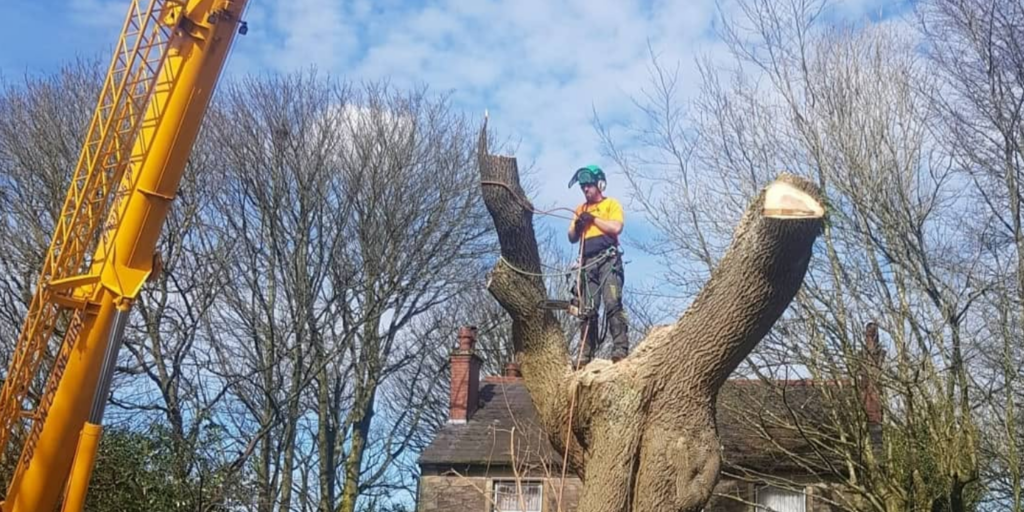
Dealing With an Overhanging Tree Dispute?
If your neighbour’s tree is growing over your garden, you may have more rights than you realise, but those rights are not unlimited. The common-law right to remove encroaching branches and roots is useful because it provides a practical way of dealing with straightforward boundary overhangs without automatically turning the matter into a legal dispute.
The biggest mistakes usually happen when people assume that the overhanging portion of the tree is somehow theirs, that they can cut beyond the boundary to make a cleaner pruning cut, that a two-metre height limit applies to individual trees, or that a protected tree can be pruned simply because it overhangs their property.
In many cases, the best solution is straightforward. Talk to the neighbour, establish the boundary, check whether the tree is protected, assess the scale of the work and then carry out appropriate pruning safely.
At Tree Care Extraordinaire, we help homeowners across Preston, Leyland and the wider Lancashire area with tree care and pruning, tree reductions, tree surveys and TPO applications and tree removal. Where the legal position is unclear, we can explain the practical tree-care considerations and help you understand what work is appropriate.
Get in touch below to discuss an overhanging tree, boundary pruning or another tree-care issue.
Frequently Asked Questions (FAQ)
Generally, no, provided you are exercising the common-law right to remove branches that have crossed onto your property and the work is carried out without entering your neighbour’s land. Nevertheless, speaking to your neighbour first is strongly recommended because it can avoid unnecessary disagreement and gives you an opportunity to agree how the work will be carried out.
Not simply because the branch is over your property. The ordinary right is to remove the encroaching growth back to the boundary. Cutting substantially into the neighbour’s side of the tree may go beyond that right and could create liability for damaging the tree.
Generally, roots that have crossed onto your land can be cut back to the boundary, but major root systems require considerable care. Cutting structural roots can affect the stability of a tree, particularly in mature specimens, so professional assessment is advisable where substantial roots are involved.
Not simply because the tree is tall or because they dislike the amount of shade it creates. The position can be different if there is an actionable nuisance, actual property damage, a genuine safety concern or a qualifying high hedge.
No. There is no general two-metre height limit for individual trees. The two-metre measurement is relevant to the statutory high-hedge framework and should not be confused with a universal limit applying to all trees.
Not simply because it is tall. The statutory high-hedge procedure applies to qualifying hedges rather than individual trees. If the tree is causing another form of actionable nuisance or damage, a different legal route may be relevant.
No. Two metres forms part of the statutory criteria for a qualifying high hedge, but it does not mean that every remedial notice simply orders a hedge to be reduced to exactly two metres.
Do not assume that you can. A TPO or conservation-area controls may apply, and the appropriate consent or notification may be required before work takes place. Check the tree’s status first using our guide on How to Find Out if a Tree is Protected.
Important Note
This article provides general information about tree and neighbour disputes and is not a substitute for legal advice. Property boundaries, nuisance claims, protected trees, access rights, wildlife restrictions and liability for damage can all depend on the specific circumstances of an individual case. Where a dispute is serious, property damage has occurred, or formal legal action is being considered, appropriate legal advice should be obtained.
References
[1] https://www.bailii.org/uk/cases/UKHL/1894/1.html
[2] https://www.legislation.gov.uk/ukpga/2003/38/contents
[3] https://www.legislation.gov.uk/ukpga/1981/69
[4] https://www.gov.uk/how-to-resolve-neighbour-disputes/high-hedges-trees-and-boundaries
[5] https://www.gov.uk/guidance/tree-preservation-orders-and-trees-in-conservation-areas
[6] https://www.gov.uk/government/publications/high-hedges-complaining-to-the-council/high-hedges-complaining-to-the-council
[7] https://www.gov.uk/your-property-boundaries
[8] https://www.gov.uk/guidance/wild-birds-protection-surveys-and-licences