Introduction
Across Leyland and throughout Lancashire, our skyline is forever changing. One factor for this change is Hymenoscyphus fraxineus, most commonly known as Ash Dieback. This chronic fungal disease has devastated millions of trees across the UK, and unfortunately, many property owners in Lancashire are now finding themselves responsible for large, increasingly unstable trees that require specialist attention. If you’re searching for a local tree surgeon for Ash Dieback removal, or wondering if your Ash tree is dead or just dormant, this guide provides the professional clarity you need in order to protect your property and your liability.
What is Ash Dieback and Why is it So Aggressive?
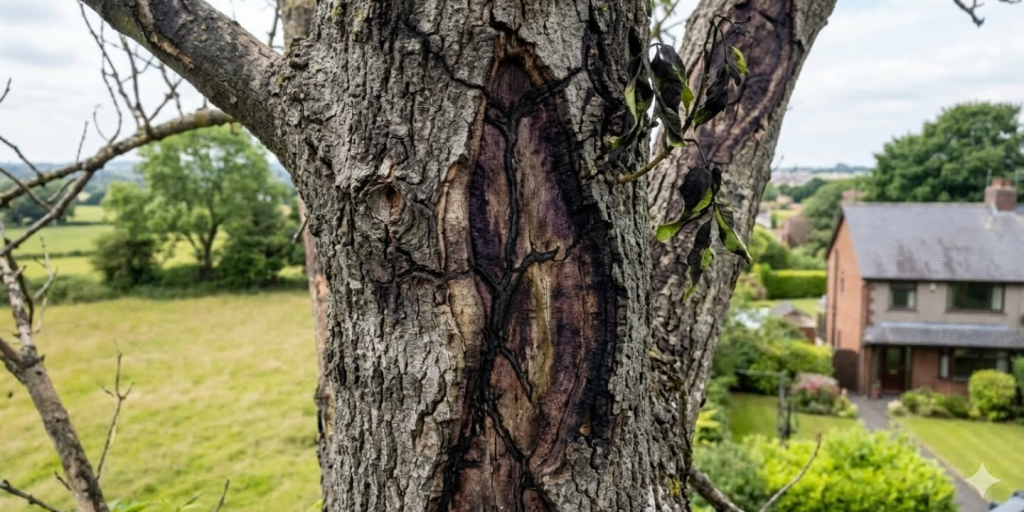
Originally introduced via imported saplings from Asia [1], Ash Dieback is a fungus that effectively “chokes” the tree by blocking its vascular system. While a mature Ash tree (Fraxinus excelsior) is one of the hardiest species in the British Isles, it has no natural evolutionary defence against this specific pathogen. The fungus produces spores on fallen leaf stalks in the leaf litter during the summer months; these spores are then wind-borne, often travelling miles to infect new hosts through the leaves and lenticels in the bark.
Why You Can’t Afford to Wait
Ash Dieback isn’t just another “sick tree” problem; it is a structural integrity crisis. Unlike many other species that decline slowly over decades, an Ash tree infected with dieback undergoes a chemical change in its timber. The wood loses the natural flexibility that makes Ash famous for tool handles and sports equipment. In a residential setting, a brittle tree is a ticking time bomb. Waiting until the next big storm to see if your tree survives is a gamble that rarely pays off for homeowners in the North West.
Can a Tree Recover From Ash Dieback?
The scientific consensus unfortunately highlights that recovery is rare in mature specimens. While roughly 1% to 5% of the UK Ash population shows a degree of genetic tolerance, [2] a tree in a domestic garden or near a public highway is under significantly more stress than one in a woodland. Once a tree shows more than 50% canopy loss, its ability to photosynthesise and store energy is crippled. [3] In a residential setting, the “wait and see” approach is often a high-risk strategy. Unlike a rural forest where a dead tree provides habitat, a dead Ash tree in a Leyland garden is a structural liability that will eventually fail. Our role as arborists is to determine if your tree is part of that resilient 5% or if it has become a “ticking time bomb” for your property.
4 Critical Signs Your Ash Tree is Infected
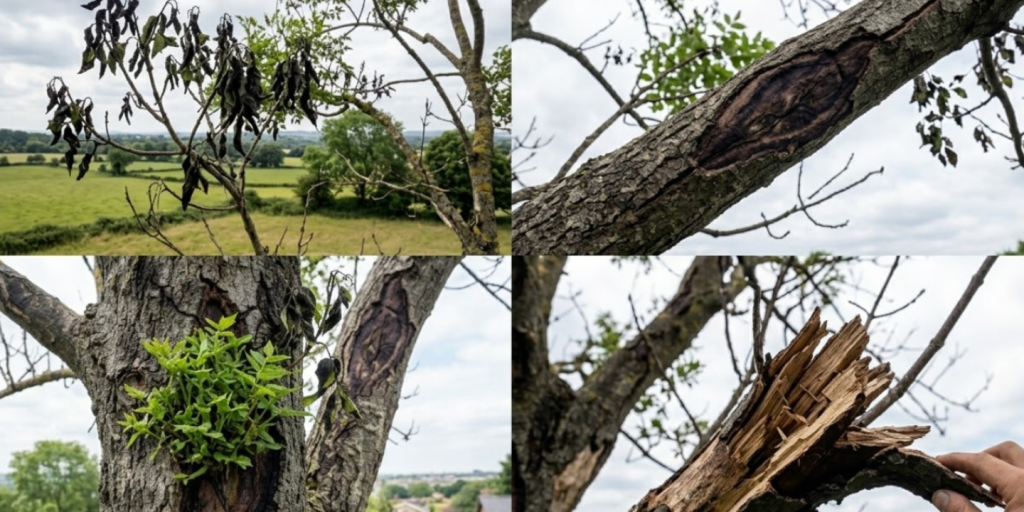
Early identification is the most effective way to manage the risks associated with Ash Dieback. Because the disease moves from the outer leaves inward toward the trunk, homeowners can often spot the decline before it becomes an emergency. Look for these four distinct warning signs:
1. Leaf Dieback and Blackened Foliage
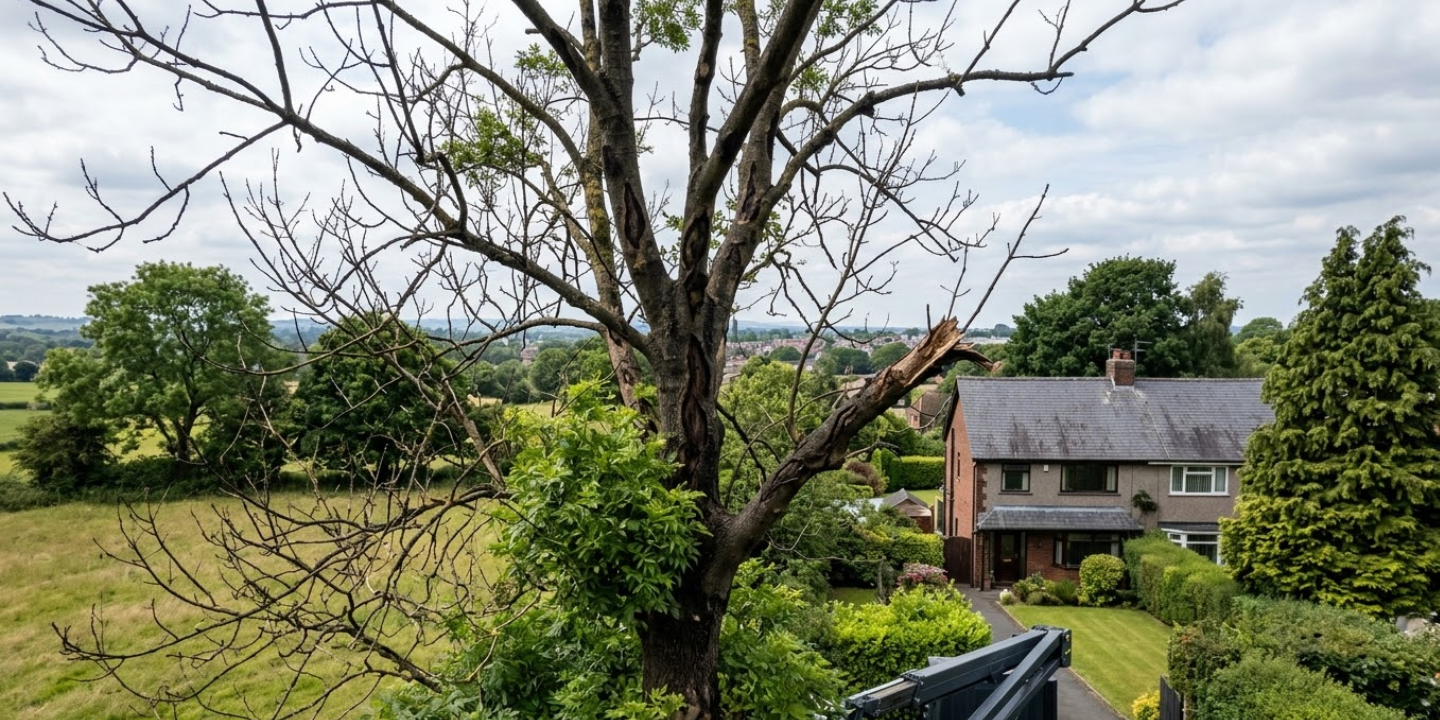
The first signs of trouble usually appear in the high canopy during mid-to-late summer. While most trees are in full, lush leaf, an infected Ash will show “clumping” or “thinning” at the tips of the branches. The leaves often turn a distinct black or dark brown, wilting while still attached to the tree. This is not to be confused with natural autumn senescence; this is the fungus physically cutting off the water supply to the furthest reaches of the tree. If you look up and see “skeleton-like” fingers reaching out of a green canopy, the infection is well-established.
2. Diamond-Shaped Lesions
As the fungus moves from the leaves into the twigs and eventually the main limbs, it creates necrotic (dead) lesions in the bark. These are typically elongated and diamond-shaped, appearing darker or sunken compared to the surrounding healthy tissue. When these lesions attach and wrap entirely around a branch, everything beyond that point will die. If these lesions appear on the main trunk, the tree’s internal structure is being systematically shut down, leading to rapid decline and structural instability.
3. Epicormic Growth
In a desperate attempt to survive, a diseased Ash tree will often sprout “epicormic” shoots. These are dense, bushy clusters of small leaves growing directly out of the main trunk or the base of large limbs. To an untrained eye, this might look like the tree is fighting back or growing new life. In reality, it is a stress response. The tree is panicking because its upper canopy can no longer produce energy, so it throws out these weak, poorly attached shoots as a final effort to stay alive. If you see a sprout of growth on the trunk of a tree with a dying top, the tree is in the final stages of decline.
4. Brittle Wood
This is the most dangerous aspect of the disease. Healthy Ash is incredibly tough, it’s what we use for axe handles and oars [4] because it can absorb shock. However, Ash Dieback changes the very cellular structure of the wood, making it hygroscopic and extremely brittle. The wood essentially becomes like glass; it doesn’t bend or creak in the wind; it simply shatters without warning. This is why we urge homeowners not to wait until the tree is completely dead to call us; the more brittle the wood becomes, the more dangerous and expensive it is to remove.
How Much Does it Cost to Remove a Large Ash tree in the UK?
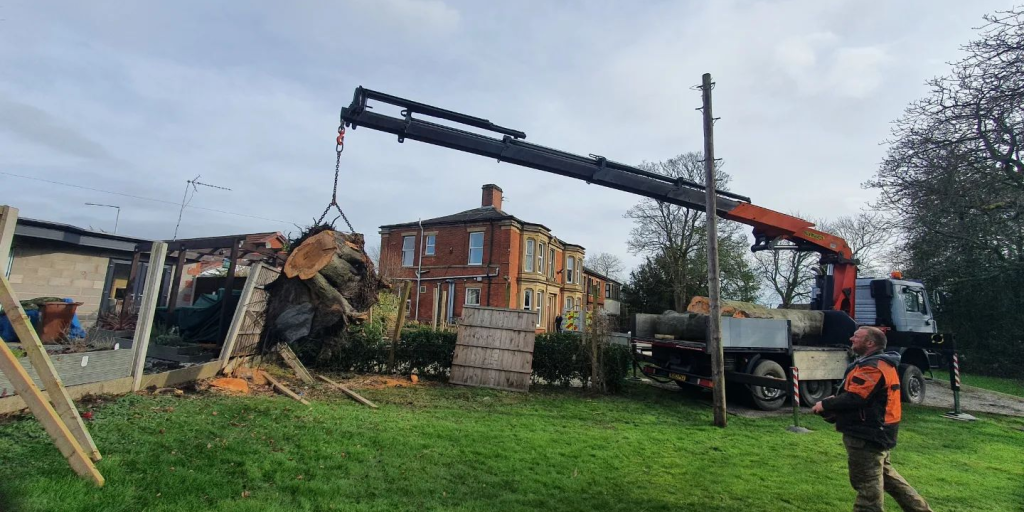
This is the most common question we receive at Tree Care Extraordinaire. Because Ash Dieback compromises the structural integrity of the wood, removal is rarely a standard felling job. The cost is dictated entirely by the complexity of the site, the proximity of the tree to your home or power lines, and how far the disease has progressed. A tree that is too brittle to climb requires significantly more machinery and man-hours to dismantle safely than a healthy tree in an open field.
Factors Influencing the Price of Ash Tree Removal in Preston
If a tree is located in an open field with no targets, it is a straightforward fell. However, most domestic Ash trees in Preston or Chorley are located near houses, sheds, or power lines. We have to sectional fell these trees, meaning we climb (if safe) or use a MEWP (see below) to lower the tree piece by piece using advanced rigging. The cost also covers the legal disposal of the infected timber; we cannot simply leave Ash Dieback logs to rot, as they will continue to produce spores. We ensure the wood is processed or moved in accordance with local environmental guidelines to prevent further spread in the North West.
Legal and Safety Reality for Homeowners
In the UK, the owner of the land on which a tree stands has a Duty of Care under the Occupiers’ Liability Act 1957 and 1984. [5] This means you are legally responsible for ensuring your trees do not pose an unreasonable risk to visitors, neighbours, or passers-by.
Mitigating Your Liability as a Landowner
If a diseased Ash tree is located within falling distance of a public road or a neighbour’s conservatory, and you have not had it professionally inspected, you could be found negligent in the event of an accident. Many homeowners are surprised to find that their home insurance may be void if they were aware of a hazard (like a visibly dead tree) but failed to act. Hiring a certified arborist provides you with a paper trail of professional due diligence which is essential for insurance purposes and peace of mind. By commissioning a survey, you are demonstrating that you have taken reasonable steps to manage the risks on your land.
Tree Preservation Orders (TPOs) and Ash Dieback
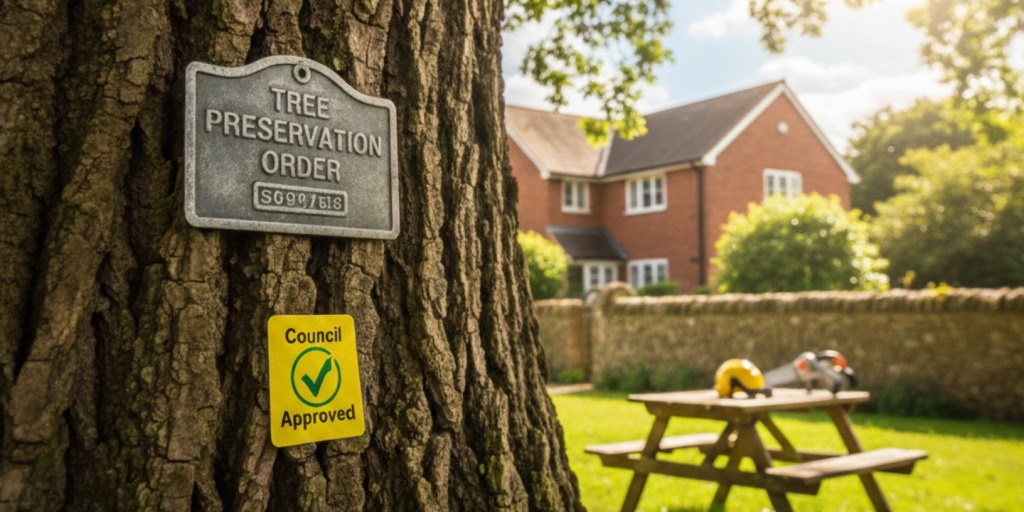
Navigating the legalities of tree work can be daunting, especially when a tree is legally protected. To understand the basics of how protection works in Lancashire, you can refer to our complete guide on finding out if a tree is protected. When Ash Dieback is involved, the process requires a technical touch to ensure you remain compliant with local planning authorities.
Can I Cut Down and Ash Tree with a TPO if it Has Dieback?
A common misconception in Lancashire is that a Tree Preservation Order (TPO) [6] or living in a Conservation Area prevents you from touching a dying tree. This is not true. While you cannot simply start the chainsaw, the law allows for work on “dead, dying, or dangerous” trees. However, the definition of “dangerous” is subjective; a tree officer will require evidence that the tree poses an immediate risk before they waive the usual six-week waiting period.
Managing Section 211 Notices and Council Liasison
However, the burden of proof is on the homeowner. You must usually submit a Section 211 [7] notice or a formal TPO application to your local council (e.g., South Ribble or Preston City Council). At Tree Care Extraordinaire, we don’t just cut the tree; we manage the bureaucracy. We provide the technical reports, photographic evidence of the lesions, and the canopy-loss percentages required by council tree officers to grant an immediate five-day notice for emergency work.
Specialist Equipment: Why We Don’t Always Climb Ash Trees
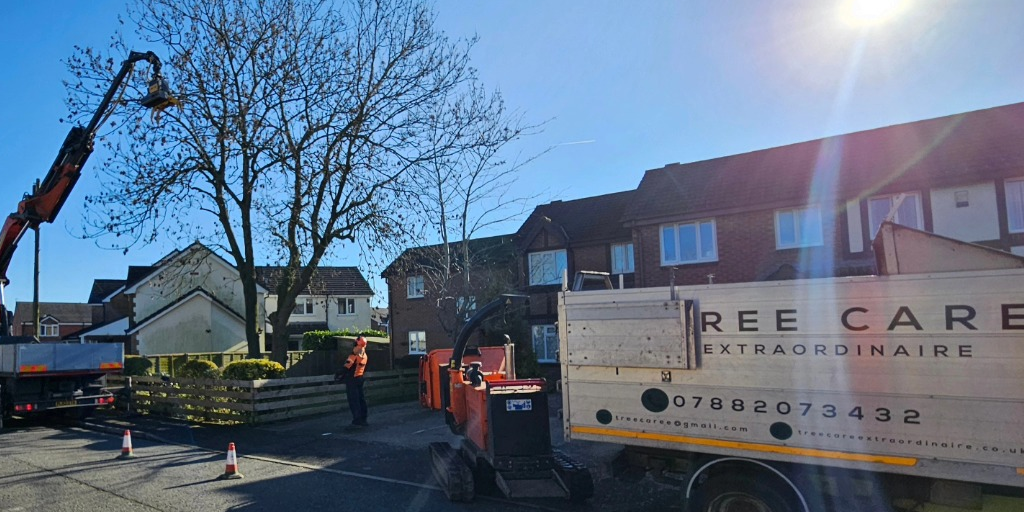
A decade ago, a tree surgeon would simply use ropes and harnesses to climb to the top of an Ash tree and start cutting. Today, with the prevalence of Dieback, climbing is often considered a last resort. Because the disease rots the tree from the inside out, the anchor points a climber usually relies on may be structurally unsound.
Safe Canopy Access: The Role of MEWPs
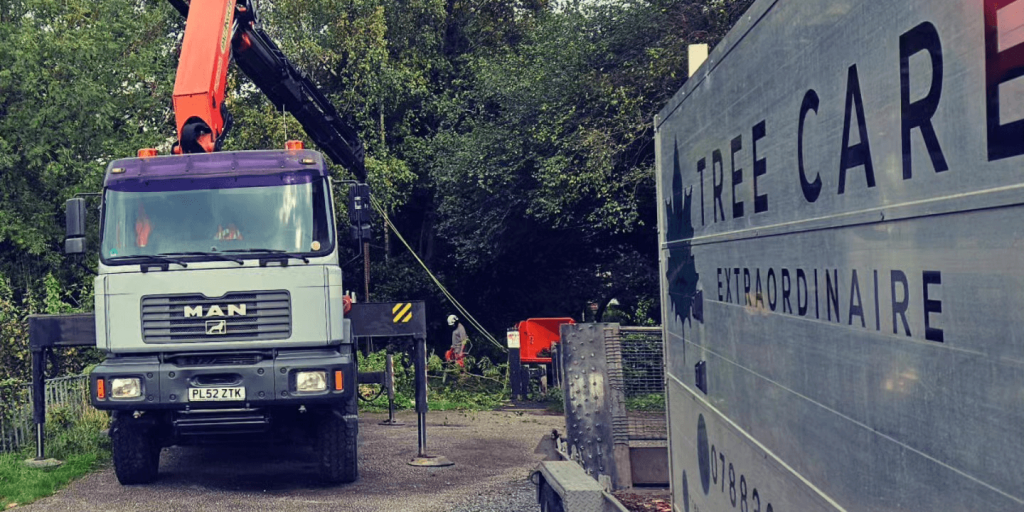
Because the wood becomes so brittle, an arborist cannot trust that a branch, or even the main trunk will hold their weight or the force of a falling limb. This is why we frequently utilise MEWPs (Mobile Elevated Work Platforms) or most commonly cherry pickers for Ash Dieback removals. This allows us to access the canopy without ever putting weight on the tree itself, significantly increasing the safety of the operation for both our team and your property.
Advanced Rigging to Protect Your Property
Using a cherry picker allows our team to reach the canopy from the safety of a bucket, where we then use specialist rigging and lowering devices to control every single piece of timber. Instead of dropping large limbs, we float them down to the ground. This low-impact approach protects your property, your fences, and your lawn from the damage caused by heavy, falling deadwood.
What You Should do Next?
If you suspect your tree is showing signs of Ash Dieback, the first step is a professional assessment. Not every tree needs immediate felling, sometimes deadwooding (removing the dangerous bits) can buy you time and reduce the immediate risk to your property. However, once the fungus has reached the main stem, the decline is often rapid. Every diseased tree needs a documented management plan to ensure you are meeting your legal obligations as a homeowner.
Request Free Specialist Ash Dieback Survey Today
Don’t wait for the next Lancashire storm to test your tree’s strength. A proactive survey is always cheaper than an emergency call-out and provides you with the expert advice needed to make an informed decision about your landscape.
References:
[1] https://forestrycommission.blog.gov.uk/2022/12/06/reflecting-on-a-decade-of-ash-dieback-response-in-the-uk
[2] https://questions-statements.parliament.uk/written-questions/detail/2025-06-09/HL8231
[3] https://pmc.ncbi.nlm.nih.gov/articles/PMC8382193/
[4] https://forestryandland.gov.scot/learn/trees/ash
[5] https://www.legislation.gov.uk/ukpga/1984/3
[6] https://southribble.gov.uk/planning-13/protected-trees/2
[7] https://www.legislation.gov.uk/ukpga/1990/8/section/211