Introduction
There’s a specific moment a lot of homeowners and land managers across Preston, Leyland, and the rest of Lancashire end up in. Standing in the garden, looking up at a tree that’s clearly not right, and trying to work out whether it needs a trim, a serious reduction, or whether it actually needs to come out completely. It’s a genuinely difficult call to make from the ground, and it’s one of the most common reasons people search for a tree surgeon in the first place, not because they’ve already decided what they want done, but because they need someone to tell them honestly what’s actually necessary.
This guide is designed to help you make sense of what you’re looking at before we even arrive on site. It won’t replace a proper inspection as some of these signs need trained eyes, and a couple need tools we bring with us, but it will help you understand what the warning signs actually mean, and why the answer is sometimes “this tree can be saved” and sometimes “this tree has to go.”
Why Getting This Decision Right Matters
Getting this wrong cuts both ways, and both mistakes are costly:
- Removing a tree unnecessarily loses a mature specimen that took decades to grow, can reduce your property’s value and privacy, and if the tree is protected, it can land you in serious legal trouble with the local planning authority.
- Leaving a genuinely hazardous tree in place risks personal injury, damage to your home, vehicles, or a neighbour’s property, and potential liability under the Occupiers’ Liability Acts if someone is hurt and it can be shown you were aware of the risk.
The goal of a proper assessment is always to find the least destructive option that actually resolves the risk, not to default to felling because it’s the simplest answer, and not to default to “leave it and see” because removal feels drastic.
The Warning Signs Worth Taking Seriously
None of these signs need to be treated in isolation, and most dangerous trees show more than one at once. What we’re really looking for is a pattern, a combination of symptoms that, together, tell a clearer story than any single sign on its own. A tree with one small area of deadwood is normal maintenance. A tree with deadwood, a fungal bracket at the base, and a new lean is a different conversation entirely.
The list below covers the nine signs we come across most often, roughly in the order we’d check them on a real site visit, starting at ground level and working up through the trunk and into the crown.
1. Fungal Brackets, Conks, or Mushrooms
This is one of the clearest indicators of internal decay, and one of the easiest for a homeowner to spot without any training. A few things worth knowing:
Honey fungus (Armillaria) is one of the most destructive fungal diseases affecting UK gardens, spreading underground via root contact and dark, root-like structures known as “bootlaces.” Clusters of honey coloured toadstools at the base of a tree in late summer or autumn are a classic sign.
Bracket fungi growing directly from the trunk or root flare, particularly large shelf-like growths, generally indicate that decay is already well established inside the wood, and by the time the fruiting body is visible externally, the internal damage has usually been developing for some time.
The presence of fungal fruiting structures doesn’t automatically mean a tree must come down immediately, but it does mean a proper assessment is needed to establish how much sound wood remains and whether the tree can still safely support itself.
2. Cavities and Hollow Sounding Trunks
A cavity you could fit a fist into, particularly near the base of the trunk or where a major limb joins the main stem, represents a meaningful loss of structural wood. Not every hollow tree is dangerous as some species compartmentalise decay effectively and remain stable for years, but the location, size, and depth of the cavity all affect how much risk it actually poses.
3. Deep Vertical Cracks
A shallow surface crack from frost or minor impact is common on older trees and rarely a concern. A crack that runs deep into the heartwood, extends for a significant length of the trunk, or appears on opposite sides of the trunk is a different matter entirely as it indicates the tree may already be in the process of splitting apart.
4. Included Bark at Co-Dominant Stems
Where a tree has two main trunks or major limbs growing at a narrow angle from a shared point, bark can become trapped in the join rather than forming a strong structural union. This is called included bark, and it’s one of the most common causes of sudden, catastrophic limb or trunk failure during storms, often with very little external warning beforehand.
5. A Sudden or Worsening Lean
Trees naturally grow with all sorts of character, and a long-standing gentle lean isn’t necessarily anything to worry about. A new lean, or one that’s visibly worsening, is a different story as it usually points to root failure, whether from root rot, soil erosion, storm damage, or root loss during nearby construction work.
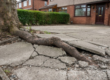
6. Root Plate Movement and Soil Cracking
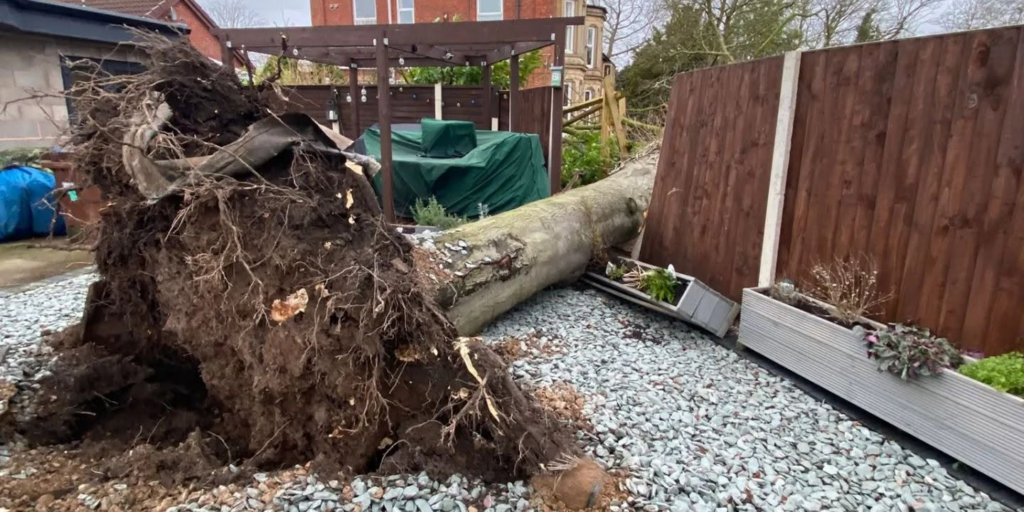
If you notice the ground lifting or cracking on the side of a tree opposite a lean, or soil visibly disturbed around the base, this suggests the root plate itself may be failing. This is particularly dangerous because a tree in this condition can fail without any further warning, sometimes in relatively modest winds.
7. Significant Crown Dieback
Extensive death of branches and foliage, particularly concentrated on one side of the crown, often signals that the root system or vascular tissue supplying that section of the tree has been compromised, whether by root damage, decay, disease, or drought stress.
8. Dead Wood and “Hangers”
Large dead branches, and especially broken branches still lodged in the canopy (“hung-up” limbs or “widow-makers”), are considered non-negotiable by professionals as they’re unpredictable, brittle, and can fall without warning regardless of the health of the rest of the tree.
9. History of Poor Previous Work
Trees that have been cut back hard at right angles rather than pruned correctly, often respond by throwing up weakly attached regrowth that is itself prone to failure years later. If a tree has clearly had this done in the past, it’s worth having its current structure properly assessed rather than assuming the previous cuts solved the problem.
Warning Signs Conclusion
Taken individually, most of these signs simply mean “this tree needs a proper look” rather than “this tree is coming down.” It’s really the combination of how many of these are present, where on the tree they’re located, and what the tree is standing next to that turns a routine observation into a genuine safety concern.
This is exactly why we’d always encourage getting a second opinion from someone qualified rather than making the call yourself from the garden, and it’s also why the next section matters just as much as the list above, knowing which of these problems can be resolved with the right pruning, and which genuinely can’t.
What Reduction Can Fix, and What It Can’t
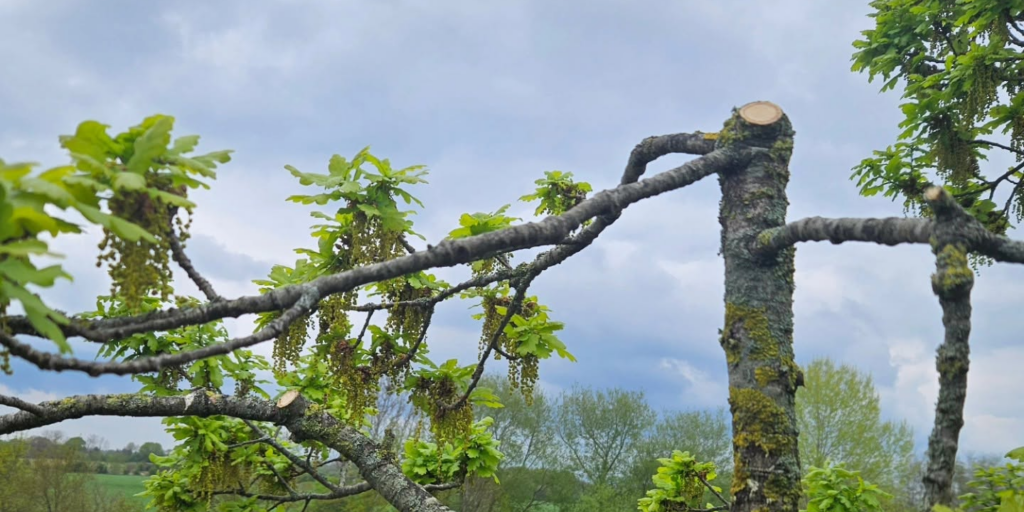
This is the distinction that actually matters most, and it’s the one we spend the most time explaining to clients, usually standing next to the tree in question. It’s also the point where a lot of the anxiety in this decision comes from as most people assume that if something is wrong with a tree, removal is the only safe outcome, when in reality the majority of the issues we’re called out for can be resolved with a well-planned reduction or a targeted removal of the affected limbs.
The tree doesn’t need to be perfect to be safe, it needs to have enough sound structure left to reliably carry its own weight and stand up to the weather it’s likely to face. Working out where that line sits is a judgement call that comes from experience as much as from any single rule, which is exactly why this section is framed as “usually,” not “always.”
Every tree we assess gets weighed up on its own condition, its own location, and what it’s standing next to, not just matched against a checklist.
A crown reduction or targeted pruning is usually the right call when:
- Deadwood is limited to specific branches rather than throughout the crown.
- A single storm-damaged limb needs removing but the main structure is sound.
- The tree is otherwise healthy but has grown too large for its position and needs its canopy or water demand reduced.
- Early-stage fungal or pest issues are localised and haven’t compromised the main structural stem.
Removal is usually necessary when:
- Decay affects a significant proportion of the main trunk’s cross-section, particularly at the base.
- Fungal fruiting structures appear on the main stem, buttress roots, or in multiple locations across the tree.
- A crack or included bark union runs through the main stem itself, rather than a secondary limb.
- The root plate shows clear signs of failure.
- The tree is dead, or the majority of the crown is affected by dieback.
Still Unsure?
If you’re unsure which category a tree falls into, that uncertainty is itself a good reason to have it looked at properly rather than guessing either way. Guessing in favour of reduction when removal was actually needed just delays the inevitable and risks the tree failing before the real problem is dealt with.
Guessing in favour of removal when reduction would have done the job means losing a tree and the value, shade, and character it adds to a property, for no real reason. A short site visit from someone qualified almost always costs far less, in every sense, than getting this particular call wrong.
Our Assessment Process
When we’re called out to assess a potentially dangerous or diseased tree, we work through a consistent process rather than making a snap call from the pavement:
- Ground Level Visual Assessment: Checking the base, buttress roots, trunk, and lower crown for the signs above.
- Sounding and probing: Using a mallet or similar tool to check for hollow sections, and where appropriate, more detailed investigation of suspected decay.
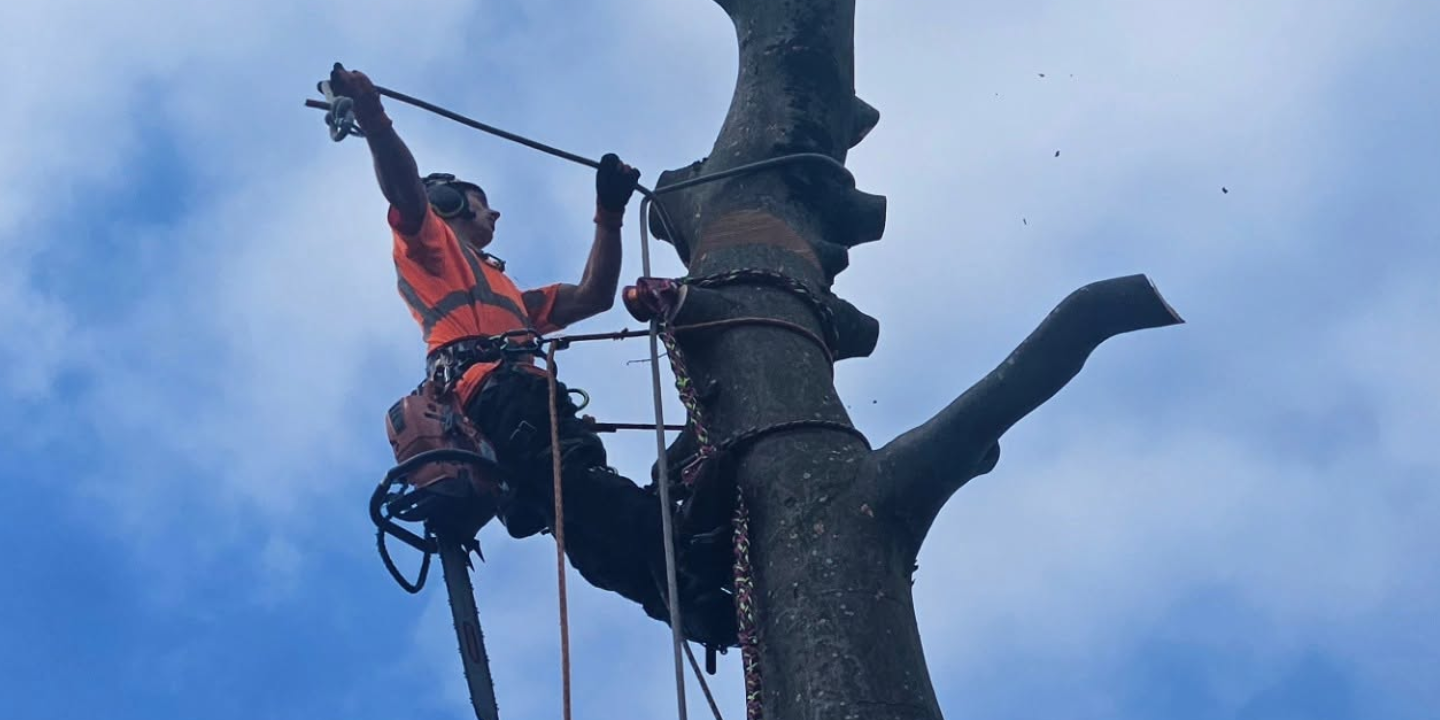
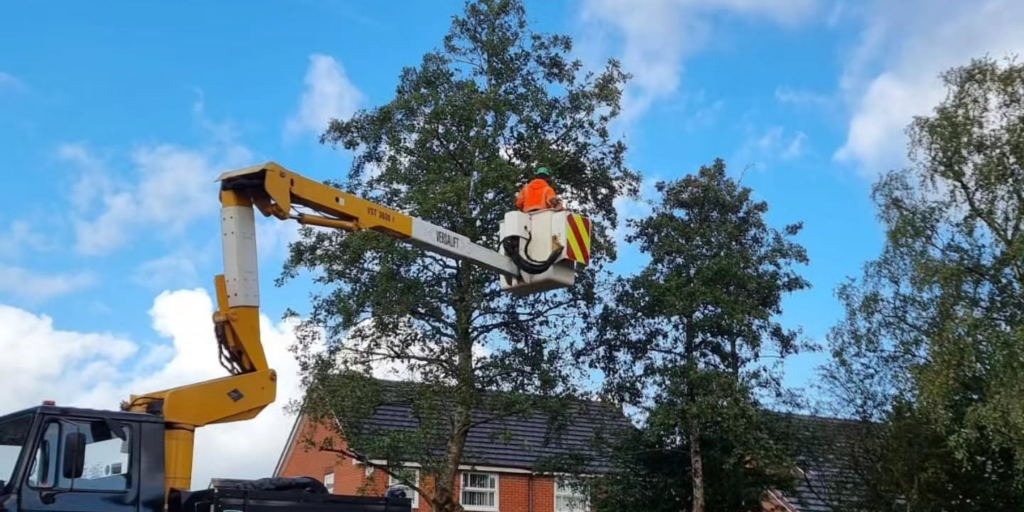
- Crown inspection: Assessing dieback, deadwood, and included bark higher in the canopy, using climbing access or aerial equipment where the ground view isn’t sufficient.
- Context assessment: Factoring in the tree’s “target” — what it would hit if it failed, whether that’s a house, a road, a play area, or open ground — since risk isn’t just about the tree’s condition in isolation.
- Recommendation: A clear, honest recommendation: monitor, reduce, or remove, explained in plain terms along with the reasoning behind it.
- Checking for protection status: Confirming whether the tree is covered by a Tree Preservation Order or sits within a conservation area, since this affects how quickly and under what process any necessary work can proceed.
Real Examples From Our Work Across Lancashire
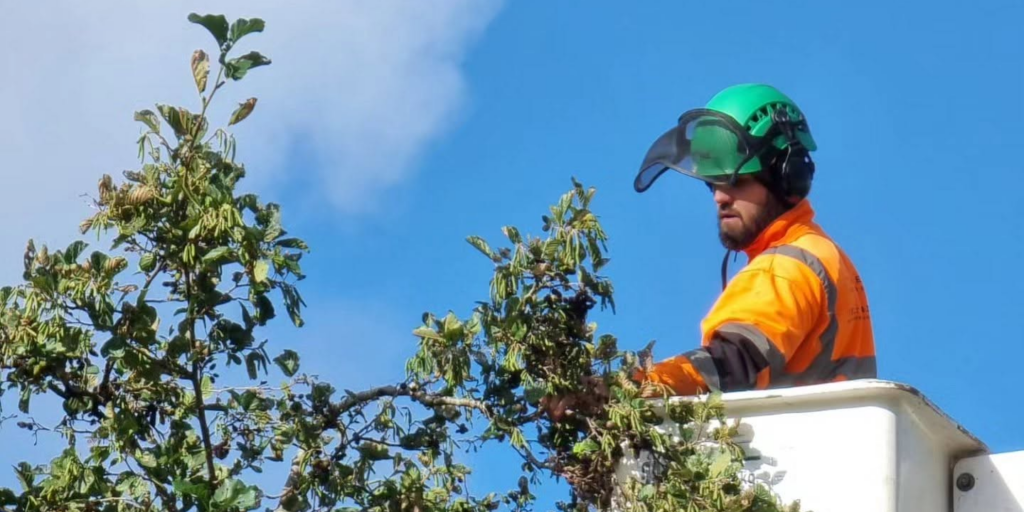
This is exactly the kind of assessment we carry out regularly across the region, and it’s worth being specific rather than vague about it:
- At a Preston Cemetery site, we assessed a mature beech affected by Meripilus giganteus, a root-decaying fungus, and carried out a significant reduction to manage the immediate risk given the tree’s size and its proximity to visitors and monuments.
- At Moor Park, a similarly affected mature beech required one of the heaviest reductions we’ve carried out, balancing the tree’s retention against the genuine structural risk posed by the same fungal decay.
- Working for Preston City Council at Avenham Park, we removed a condemned horse chestnut and ash that had been assessed as being in serious decline, where reduction alone wouldn’t have addressed the underlying risk.
- Our Ash Dieback removal project involved felling a mature ash affected by Chalara ash dieback which is a disease with no effective cure, where the assessment process is less about “can this be saved” and more about managing the safe timing and sequencing of removal before the tree becomes structurally unpredictable.
- Following storm damage at Lostock Grove Care Home, root plate condition was central to how we approached the removal safely, given the vulnerable residents on site.
These aren’t hypothetical scenarios, they reflect the same decision-making process described above, applied to real sites across Preston, Leyland, and the wider Lancashire area.
What This Usually Costs, and How Urgently You Should Act
Cost and timescale depend heavily on the category above. A targeted deadwood removal is a very different job to a full removal of a large, decayed tree in a restricted access site. Our guide on how much do tree surgeons charge gives a general sense of pricing.
If the tree shows several of the higher-risk signs above, particularly root plate movement, main-stem cavities, or fungal brackets on the trunk itself, this isn’t a job to defer for “next season.” Our tree removal and tree surveys and TPO applications services cover exactly this kind of work, from the initial assessment through to safe removal.
Concerned About a Tree on Your Property?
If you’ve spotted any of the signs above, or you simply want an honest opinion before deciding what to do, get in touch with your location and a description (or photo) of what you’re seeing. We’ll give you a straight answer on whether the tree needs monitoring, reducing, or removing.
Frequently Asked Questions (FAQ)
Sometimes, yes. It depends on the fungus species, how much of the tree is affected, and where. A localised, early-stage infection on a secondary limb is a very different situation to fruiting bodies appearing on the main trunk or root flare. This is exactly why a proper assessment matters rather than assuming any fungus means the tree is finished.
No. Many trees develop a natural, long-standing lean as part of normal growth and remain perfectly stable for decades. The concern is specifically a new or worsening lean, which points to root failure rather than simply growth habit.
If the tree is protected by a Tree Preservation Order or sits within a conservation area, you generally still need permission, however most councils allow emergency “make-safe” work where there’s a genuine, provable immediate danger. Our Tree Surveys and TPO Applications service handles this process for clients regularly.
It varies, but dead branches and trees with significant root or trunk decay can fail without warning, and are more likely to do so in storms or after heavy rain saturates the soil. This is why we treat deadwood and confirmed structural defects as something to act on rather than monitor indefinitely.
That uncertainty is precisely the reason to get a professional opinion. The cost of an assessment is minor compared to either losing a tree unnecessarily or leaving a genuine hazard in place.
References:
https://www.rhs.org.uk/disease/honey-fungus
https://www.hse.gov.uk/treework/index.htm
https://www.forestresearch.gov.uk/tools-and-resources/fthr/pest-and-disease-resources/chronic-oak-decline-dieback/biotic-and-abiotic-factors-which-contribute-to-oak-decline/armillaria-honey-fungus/